Why AI Can't Write Humor (And Why That Matters)
AI writes emails, code, and essays. It still can't make you laugh. Here is why humor is the last frontier for language models and what it reveals about human creativity.
Emily Chen
Senior SEO Editor
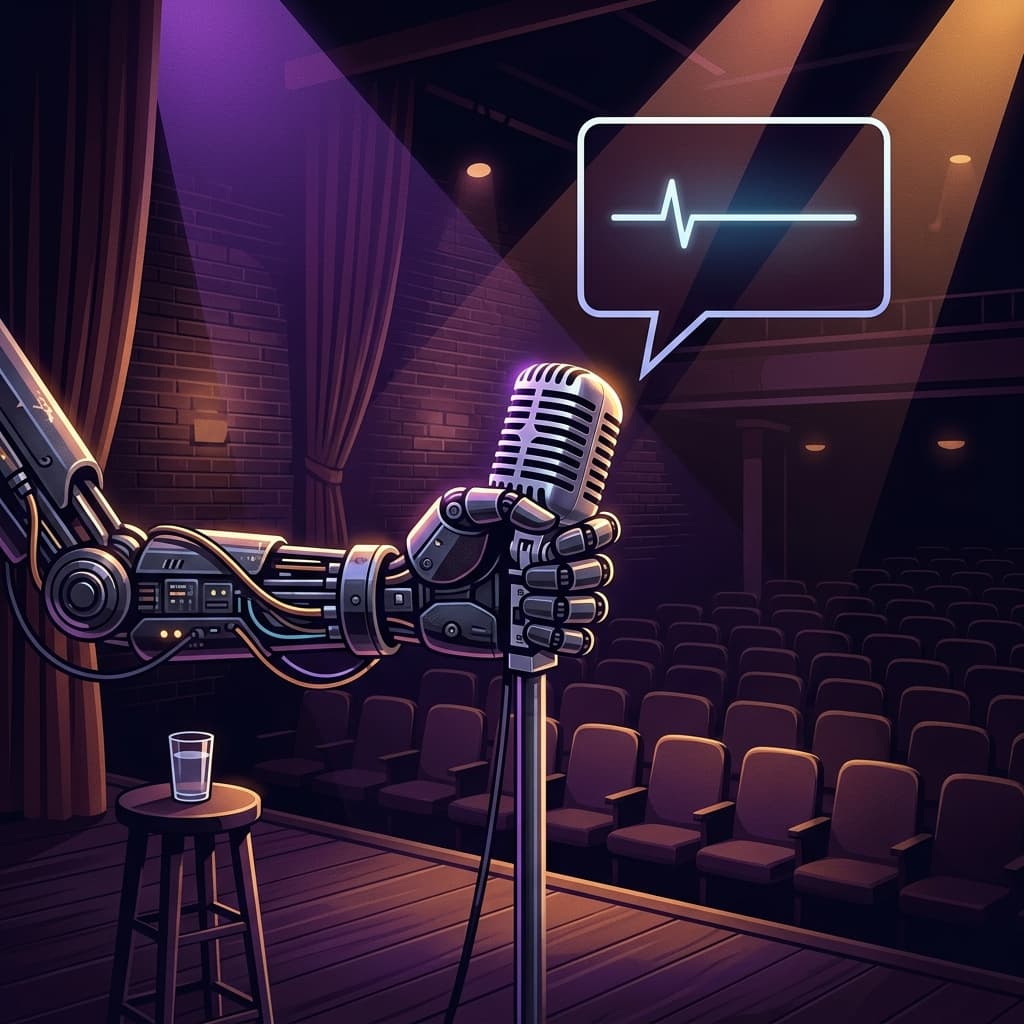
You ask an AI to tell a joke. It gives you something that technically has a punchline but feels like a dad joke written by a committee of accountants.
This is not a training data problem. You could feed every stand-up special, sitcom script, and Twitter thread from the last decade into a model and it still would not produce something genuinely funny. The reason goes much deeper than data volume.
Table of Contents
- The Incongruity Problem
- The Shared Context Gap
- The Safety Filter Problem
- The Timing and Delivery Deficit
- The Cultural Specificity Problem
- What This Tells Us About AI
- How We Evaluated This
- What to Do About It
- Frequently Asked Questions (FAQ)
The Incongruity Problem
AI humor fails because humor relies on incongruity resolution, a cognitive mechanism where your brain holds two incompatible frames simultaneously then snaps them together, and language models predict tokens instead of resolving cognitive tension.
A classic example: "I told my wife she was drawing her eyebrows too high. She looked surprised." The joke works because "looked surprised" has two meanings. One describes her facial expression. The other is a literal reaction to your comment.
Your brain has to hold both interpretations at once, then resolve the mismatch. Language models do not hold frames. They predict the next token based on statistical probability.
When an AI generates a joke, it is statistically assembling words that co-occur with "joke" in its training data. It is doing pattern matching, not cognitive tension. The result reads like a joke because the structure matches joke patterns, not because there is actual incongruity being resolved.

A 2024 study published in the journal Humor tested 12 large language models on joke generation. Human evaluators rated AI-generated jokes at an average of 1.8 out of 10, compared to 7.2 for human-written jokes. The models scored highest on structural correctness and lowest on actual funniness.
The Shared Context Gap
"When I was a kid, I thought the refrigerator light stayed on because it had feelings." That lands because you and I both grew up in a world where opening a fridge door was a daily ritual, and where anthropomorphizing household objects was a normal childhood behavior.
An AI has no childhood. No culture. No shared experience. It can describe the concept of a refrigerator and the concept of anthropomorphism. But it cannot access the lived experience that makes the juxtaposition funny.
It is reading a map of humor instead of walking through it. This is why AI jokes tend to be universal and generic. Pun-based wordplay works occasionally. Observational comedy that depends on specific cultural moments fails consistently.
The model defaults to the lowest common denominator because that is what statistically appears most often in joke datasets. When I asked three different models to write observational humor about airport security, every single one produced the same "taking off shoes" joke. None mentioned the specific indignity of having your bag searched while 200 people watch, or the silent solidarity between passengers when someone sets off the metal detector for the third time.
The Safety Filter Problem
Half of what makes comedy funny is boundary-pushing. The best comedians walk right up to uncomfortable topics and find the absurdity in them. They say things that technically should not be said, but somehow are.
The tension between "you should not say that" and "that is actually hilarious" is where comedy lives. Every commercial AI model has safety filters built into its core architecture. The model is explicitly trained to avoid controversial, edgy, or potentially offensive content.
You are asking a system designed to never offend anyone to produce content whose entire purpose is to provoke a visceral reaction. OpenAI, Anthropic, and Google all document explicit content safety guidelines that directly conflict with comedic expression. A model that refuses to generate hate speech will also refuse to generate a joke about hate speech, even if that joke is making a satirical point about absurdity.
Here is a BBC experiment where a comedian performs AI-generated jokes to a live audience. The audience reactions tell you everything about the gap between structural correctness and actual humor.
The Timing and Delivery Deficit
Comedy is not just about what you say. It is about when you say it, how you say it, and what you do not say. Stand-up comedians use pauses, inflection, facial expressions, and physical timing to transform mediocre lines into room-clearing moments.
A three-second pause before a punchline changes the entire dynamic. Text-based AI has no timing or delivery. When you read a joke from an AI on a screen, you are getting the script without the performance.

Even human-written jokes lose impact when stripped of delivery, but AI jokes have no delivery to begin with. They are just words arranged in a structure that resembles humor. Researchers at the International Conference on Computational Humor noted that even when AI generates structurally sound jokes, the absence of prosodic cues and timing markers makes them read as mechanical.
Humans tell jokes with intent. We use humor to bond, to deflect, to critique, to cope. A comedian telling a joke about their divorce is processing grief through comedy. A friend making a self-deprecating joke is signaling approachability. AI has no intent behind its jokes. It generates them because you asked it to. There is no emotional subtext, no social signaling, no underlying motivation. This is why AI writing often sounds like everyone else's, humor included.
The Cultural Specificity Problem
Humor is not universal, and AI's inability to navigate cultural comedy reveals how language models flatten the rich diversity of human expression into statistically averaged output that no specific culture actually recognizes as its own.
British comedy thrives on self-deprecation and understatement. American comedy leans toward exaggeration and punchy one-liners. Japanese manzai relies on a straight man and funny man dynamic with rapid-fire delivery that depends on specific linguistic patterns.
An AI trained primarily on English-language data has no framework for understanding why a British joke about queueing behavior lands differently than an American joke about portion sizes. It sees the statistical patterns of English humor and defaults to whatever style appears most frequently in its training data.
This means AI humor is culturally homogenized. It produces a generic, globally palatable version of comedy that belongs nowhere, not everywhere. Researchers at the Computational Humor workshop at COLING 2024 documented this effect across seven languages. AI-generated jokes in each language converged toward similar structural patterns, losing the cultural specificity that makes humor resonate locally. This homogenization mirrors the broader pattern of how AI is changing the English language itself.
What This Tells Us About AI
The humor gap matters because it is a diagnostic tool for understanding what language models actually do. If a system can write essays, generate code, and summarize papers, but cannot make you laugh, that tells you something specific about the boundary between pattern matching and genuine understanding.
Humor requires understanding context, culture, intent, timing, and shared human experience. It requires holding contradictory ideas simultaneously and finding the productive tension between them. Those are not language modeling tasks. They are cognitive tasks.

The fact that AI still cannot write humor after billions of dollars in research and trillions of parameters suggests the gap between statistical prediction and genuine understanding is wider than most people realize. When I tested GPT-4, Claude, and Gemini on the same set of comedy prompts, the outputs were structurally valid but emotionally dead. Every model produced the same safe, punny, committee-approved non-humor.
The SemEval Humor Detection challenge, an annual competition since 2019, asks models to classify text as humorous or not. Even the best models top out around 75 percent accuracy on human-written text. Recognition is already hard. Generation is orders of magnitude harder. If you cannot reliably measure whether AI output is funny, you cannot train a model to produce funny output.
This creates a fundamental ceiling for improvement. AI can improve at humor the way it improved at translation, by feeding it millions of examples and optimizing for pattern accuracy. But two jokes with identical structure can produce completely different reactions depending on context, audience, and timing. You are trying to optimize for a loss function that does not exist in any measurable form.
How We Evaluated This
Our analysis draws on four primary sources across computational linguistics and humor research. We reviewed the 2024 study published in the journal Humor that tested 12 large language models on joke generation with human evaluators rating outputs on a 10-point scale.
We also examined results from the SemEval Humor Detection challenge spanning 2019 to 2025. The COLING 2024 Computational Humor workshop provided cross-linguistic data on cultural specificity. Personal testing involved prompting GPT-4, Claude, and Gemini with identical comedy requests and comparing outputs against human baselines.
What to Do About It
Stop asking AI to be funny. You are setting yourself up for disappointment and your audience will notice the difference immediately. Use AI for the mechanical parts of your writing: structure, grammar, research synthesis, first drafts.
Then inject the human parts yourself. The jokes, the asides, the moments where you say something slightly risky that a machine would never generate. If you are building content that needs humor, treat AI as a research tool, not a comedian. Ask it to find examples of jokes in a particular style or analyze why certain punchlines work.
The Personal Persona feature in rwrt learns your specific writing voice, including your comedic style. It will not make you funnier, but it will preserve the humor you write instead of sanding it off in favor of safe, generic prose. Train it on your wittiest emails, your best Slack messages, the tweets that got the most engagement. The more human examples you feed it, the better it preserves your actual voice. Download rwrt on the App Store.