How AI Is Changing the English Language
AI is reshaping English: shorter sentences, simpler vocabulary, homogenized tone. Real studies show what's happening and why it matters.
Emily Chen
Senior SEO Editor
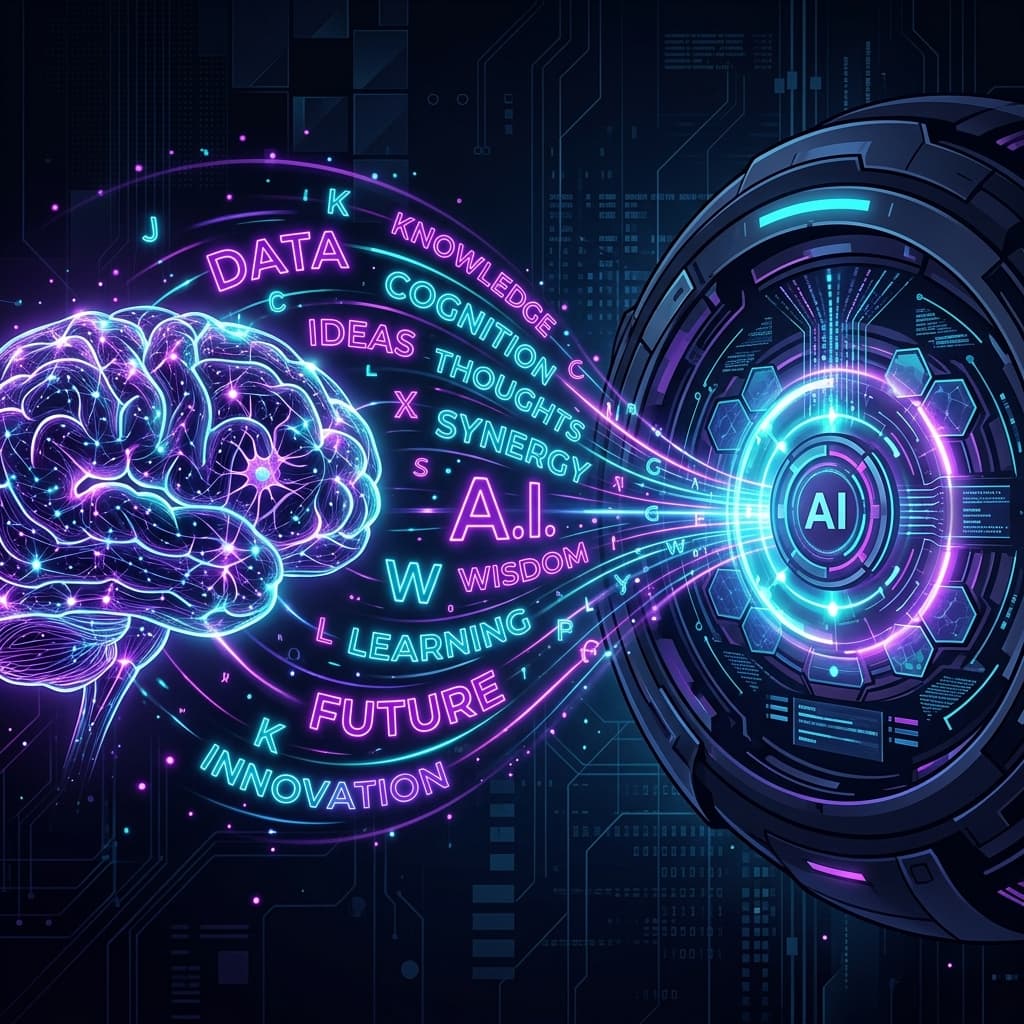
Every time you ask ChatGPT to rewrite an email, you're not just editing your draft. You're editing the language itself.
This is not a metaphor. Florida State University researchers analyzed 22.1 million words from unscripted podcast conversations before and after ChatGPT's 2022 launch. They found that words AI models overuse like "surpass," "boast," and "strategically" surged in spoken English, while their everyday synonyms stayed flat. Nearly three-quarters of the AI-associated words they tracked grew in frequency. Some more than doubled.
They call it the "seep-in effect." Machine phrasing leaking into human speech, one email at a time.
The Seep-In Effect: AI Putting Words in Your Mouth
Here is what actually happens. You open ChatGPT and type "rewrite this email to sound more professional." It gives you back something with "I hope this message finds you well" and "please do not hesitate to reach out." You copy it. You send it.
Now your colleague reads that phrasing. Now your colleague's brain registers those words as normal business communication. Now your colleague uses them in their own emails.
The chain reaction is invisible and accelerating. By the time you notice your vocabulary shifting, it has already happened.
The FSU study examined words across tech and science podcasts because podcasters speak naturally without scripts. If AI-associated language shows up there, it has already escaped the document and entered the air. The researchers tracked words like "underscore" and "garner" and "delve" that LLMs disproportionately generate.
"Underscore" spiked. Its synonym "accentuate" did not move. This is not a general trend toward fancier language. It is a specific migration toward the vocabulary that AI models happen to favor.
The study was published in the AIES Proceedings in 2025 by Anderson, Galpin, and Juzek. The principal investigator, Tom Juzek, put it bluntly: AI may literally be putting words into our mouths.
Shorter Sentences. Simpler Words. Less Variation.
The seep-in effect is just the surface layer. Beneath it, AI is restructuring English grammar itself.
A 2026 study in PNAS by researchers at CMU and elsewhere compared human-written text against LLM-generated text across multiple genres. The findings were stark. AI English uses shorter sentences on average. It favors simpler vocabulary.
It produces less syntactic variation. Where a human writer might mix a compound sentence with a fragment and a dependent clause, the AI defaults to a uniform subject-verb-object pattern repeated across paragraphs.
Laura Aull, a linguist at the University of Delaware who studies the institutionalization of English, calls AI output "exam English." It is the formal, dense, conventionally correct language that standardized tests reward. It lacks the variation and accessibility that make human writing readable.
She demonstrated this with a simple text message comparison. A human wrote: "i'm not sure how to break this to you. there's no easy way to put it...i can't make the friday-night fun. sorry." ChatGPT produced: "Hey! I'm really sorry, but I won't be able to make it Friday night. I hope you all have a great time."
The human text has lowercase, ellipses, hedging, personality. The AI text has perfect capitalization, parallel clause structure, and zero character.
This is not a bug. It is what the model is optimized for. LLMs predict the next most probable token, and probability always favors the average.
The average sentence is shorter. The average word is commoner. The average tone is neutral.
The Homogenization Nobody Is Talking About
The structural changes are measurable. The cultural consequences are harder to quantify but no less real.
MIT researchers ran an experiment where students from universities around Boston wrote SAT-style essays. One group wrote alone. One group used Google Search. One group used ChatGPT.
They wore EEG headsets throughout. The ChatGPT group showed less brain activity overall, fewer connections between brain regions, and reduced alpha connectivity linked to creativity. Eighty percent could not quote a single sentence from the essay they supposedly wrote.
But the linguistic finding mattered more than the neurological one. The essays from ChatGPT users converged on nearly identical phrasing and arguments. Different people, different days, completely similar output.
When asked about philanthropy, every ChatGPT user argued in favor. The other groups included critiques. "Average everything everywhere all at once," lead researcher Nataliya Kosmyna said.
Cornell researchers replicated this pattern cross-culturally in April 2026. American and Indian participants wrote about their favorite food and holiday. The group using AI autocomplete produced essays that became more similar to each other and shifted toward Western norms. AI-assisted writers of both cultures most frequently named pizza as their favorite food and Christmas as their favorite holiday. An essay about chicken biryani written with AI help dropped specific ingredients like nutmeg and lemon pickle in favor of "rich flavors and spices."
USC Dornsife researchers published a comprehensive analysis in early 2026 showing that LLMs consistently reflect what they call "WHELM" perspectives: Western, high-income, educated, liberal, male. When millions of people use these models to draft messages, the cultural differences in communication style start to flatten.
Why This Is Worse Than You Think
Language is not just a tool for transmitting information. It is the operating system of thought. When you lose linguistic variation, you lose cognitive variation.
This is not a Luddite take. I use AI every day. I use it to draft blog posts, rewrite awkward phrasing, and generate code. The tool is genuinely useful for specific tasks. But usefulness does not mean harmless.
The real danger is not plagiarism. Anyone who thinks the AI language problem is about students cheating on essays has not been paying attention. The danger is that we are slowly training ourselves to think in the shape that LLMs produce.
Short sentences. Simple words. Neutral tone. Consensus opinions.
It is like eating food that is technically nutritious but has no flavor. You will not starve. You will not enjoy it. And over time, you will forget what real food tastes like.
Colin Cooper, a human behavior analyst, called it "the subtle erosion of individuality." Everyone sounds polished, templated, safe. At the expense of tone, texture, and authenticity.
Consider the hyphen. AI models use it far more frequently than humans do. A 2025 analysis by Brent Sutoras documented how punctuation became AI's "stubborn signature." People now associate certain structures with machine-generated text. That is a linguistic change driven entirely by algorithmic preference, not by organic language evolution.
Or look at the rise of "delve." It was already an AI buzzword in 2023. The FSU study confirmed it surged in spoken English after ChatGPT's release. Nobody chose "delve" because it was the right word. They chose it because the machine suggested it, and suggestion becomes habit becomes norm.
What You Can Actually Do About It
This is not a problem you solve by deleting ChatGPT from your phone. The models are too embedded, too convenient, too deeply woven into daily work. The solution is awareness, not avoidance.
Read your AI-generated text aloud before sending it. Your ear will catch the flatness your eye misses. If it sounds like every other email you've received this week, rewrite it.
Keep a personal style guide. Write down three phrases you use naturally that AI would never generate. Use them deliberately. "I'm not sure how to break this to you" beats "I hope this message finds you well" every time.
Mix in deliberate imperfection. Fragments, asides, lowercase where grammar says uppercase. The goal is not to be wrong. The goal is to be human.
Curate your AI exposure. Use small language models for tasks that do not need billions of parameters. Learn to rewrite awkward phrasing without generic tools. Choose translingual chatbots that incorporate global variation instead of defaulting to Western English norms.
Track your own vocabulary. If you catch yourself saying "underscore" or "garner" or "delve" in casual conversation, notice it. That is the seep-in effect in real time. Awareness is the only circuit breaker.
Language evolves from human experience, not from the statistical average of everything ever posted online. AI has already changed English. The question is whether we let it change English into something we no longer recognize.
rwrt helps you keep your voice intact while still using AI as a tool. Try it on the App Store.