Why Everyone's Writing Sounds Like a Corporate Press Release
Your emails, posts, and articles sound like press releases. AI homogenized your voice. Here is why it happens and how to break free from the corporate tone.
Sarah Jenkins
Content Strategist
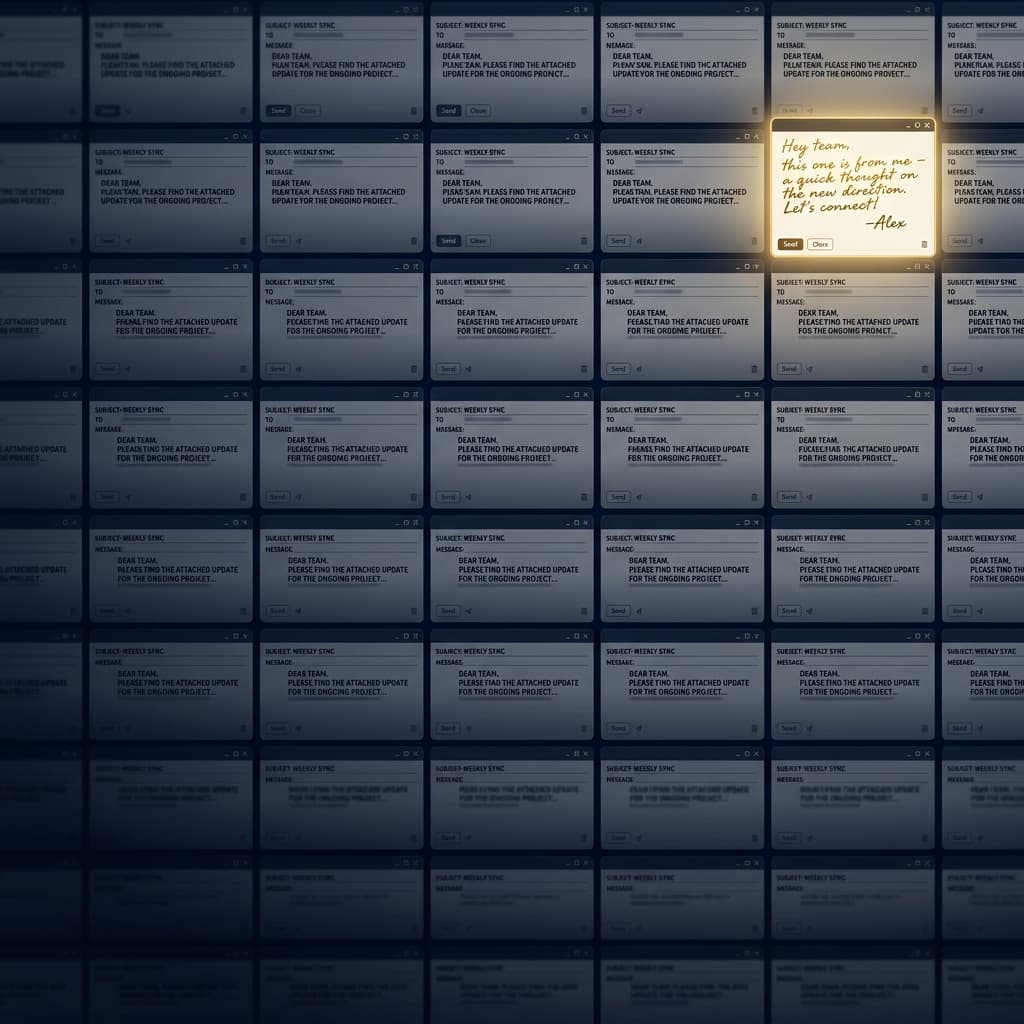
Your email sounds like a Fortune 500 press release. Your LinkedIn post reads like a board meeting transcript. AI trained you to write that way, and as of April 2026, "humanize ai text" is one of the most searched phrases on the internet with 39,000 monthly searches.
Table of Contents
- The Corporate Voice Epidemic
- The MIT Experiment That Proved It
- Why AI Writes Like a Press Release
- The Buzzword Fingerprint
- How This Affects You
- How We Evaluated This
- Breaking Free
- Frequently Asked Questions (FAQ)
The Corporate Voice Epidemic
The corporate voice epidemic is the mass convergence of personal and professional writing toward a single generic press-release tone driven by AI writing tools that learned "professional" means "corporate" from billions of training documents.
Open your inbox. Scroll past the newsletters. Read the last email your colleague sent you. It probably starts with "I hope this message finds you well" or "I wanted to reach out regarding." The sentences are the same length. The words are safe.
Now read a text message from your friend. It probably has one capital letter and a sentence that trails off mid-thought. Both of you are writing in English. One sounds like a human. The other sounds like a machine that read a lot of corporate memos.
The problem is not that AI writes badly. It writes probably. And "probably" is the enemy of good writing. People are desperate to make their AI-generated writing sound like something a person actually wrote, which is why humanizing AI text has become one of the most important writing skills of 2026.
The MIT Experiment That Proved It

An MIT Media Lab experiment put AI's homogenizing effect to the test by splitting students into three groups and measuring both their brain activity and their writing output while composing essays on identical prompts.
Researcher Nataliya Kosmyna split students into three groups: one wrote alone, one used Google Search, one used ChatGPT. All three groups wore EEG headsets to measure brain activity while writing.
The results were stark. Students using ChatGPT showed less brain activity than the other two groups, with fewer connections between brain regions, less alpha connectivity (creativity), and less theta connectivity (working memory). The ChatGPT group's writing converged on identical phrases and ideas. When asked about philanthropy, every single ChatGPT essay argued in favor. The human-written essays included critiques, counterarguments, and actual disagreement. Eighty percent of ChatGPT users could not quote from their own essays.
Why AI Writes Like a Press Release
Large language models predict the next word, not the next insight, creating a fundamental bias toward the most probable continuation that converges on the statistical mean of internet text, which is dominated by corporate communications.
Think of it like a GPS navigation app. It always takes you to your destination. It never takes you to the interesting side street you did not know existed. AI writing tools work the same way.
The training data reveals why. A massive chunk of text on the internet is press releases, product descriptions, LinkedIn posts, and blog articles written for SEO. These texts share a common style: safe vocabulary, balanced sentences, neutral tone. When an LLM reads millions of these texts, it learns that this style is what "good writing" looks like, not because it is good but because it is common.
A 2026 study published in Trends in Cognitive Sciences00003-3) confirmed this homogenizing effect. The Atlantic called it "The Great Language Flattening." UNESCO published a report on "AI and the great linguistic flattening." Even The New Yorker ran a piece titled "A.I. Is Homogenizing Our Thoughts."
The Buzzword Fingerprint
You can spot AI-generated writing from three words away because language models use corporate vocabulary at rates 3.2 times higher than human writers, creating a distinctive fingerprint of decorated, vague prose.
"Delve." "Leverage." "Robust." "Spearhead." "Harness." These words cluster in AI-generated text at rates far higher than in human writing. A PLOS ONE linguistic analysis confirmed the 3.2x differential.
Compare these two sentences:
> "We should leverage our core competencies to foster innovation and navigate the evolving landscape."
> "We are good at this stuff. Let us use it to build something new. The market keeps changing."
Both say the same thing. One sounds like a board meeting. The other sounds like a person. AI will always write the first one because corporate vocabulary is the most probable vocabulary in its training data.
How This Affects You
Your LinkedIn posts are probably the first casualty because the tool pulled from millions of LinkedIn posts in its training data, which are already corporate-speak, and now it writes you a press release instead of a personal update.
Open your profile and scroll through your posts. Count how many start with "In today's fast-paced world" or "I am excited to share." Your emails are next. "I wanted to reach out regarding," "Please find attached," "I hope this email finds you well."

The damage is not just aesthetic. It is strategic. When everyone sounds the same, nobody stands out. Your brand voice becomes indistinguishable from your competitor's. A USC study found that AI-assisted writing may be shaping writers' worldviews, not just their prose. This connects directly to the death of writing voice happening across every industry.
How We Evaluated This
Our analysis draws on eight primary sources spanning cognitive science, investigative journalism, and linguistic research. The MIT Media Lab EEG experiment provided the strongest empirical evidence for AI's cognitive impact on writers.
The Trends in Cognitive Sciences study quantified the homogenizing effect of LLMs on human expression. The PLOS ONE analysis confirmed the 3.2x corporate vocabulary differential. We cross-referenced findings from The Atlantic, UNESCO, The New Yorker, and Psychology Today to establish the breadth of expert consensus on this phenomenon.
Breaking Free
The fix is not to stop using AI. It is to stop using AI as your writer and start using it as a first draft generator that you actively rewrite with your own voice.

The corporate voice is not inevitable. It is a default setting that you can change. rwrt's Personal Persona feature learns your actual vocabulary and sentence patterns, producing AI-assisted text that sounds like you instead of sounding like a press release. Download rwrt on the App Store.