Why AI Writing Gets Worse the Longer It Goes
AI writing degrades the longer it runs. Perplexity climbs, coherence drops, and the text spirals into nonsense. Here is the math behind the decay.
Marcus Thorne
Technical Content Writer
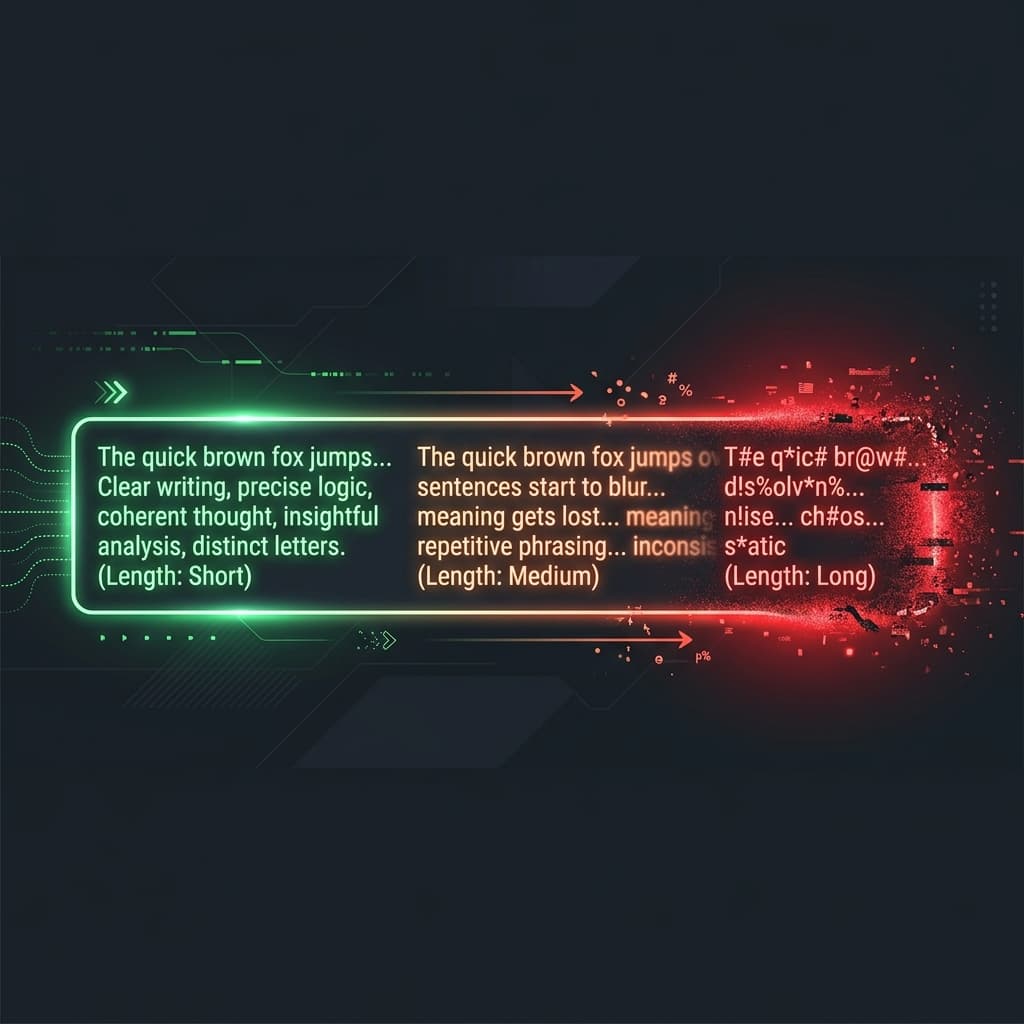
Ask AI to write 200 words. It is good. Ask it to write 2,000. It is worse. Ask it to write 10,000. It is incoherent. There is a mathematical reason why this happens, and it is built into how every large language model works.
Table of Contents
- The First 500 Words Are Fine
- Perplexity and the Quality Spiral
- Context Rot
- The Entropy Problem
- Why Long-Form AI Writing Fails
- How We Evaluated This
- How to Write Long Pieces with AI
- Frequently Asked Questions (FAQ)
The First 500 Words Are Fine
AI writing entropy is the measurable degradation in language model output quality as generated text length increases, caused by rising uncertainty in token prediction that compounds with every word the model produces.
Generate a 500-word article with any AI model. It will be decent, coherent, grammatically correct. Maybe a little generic, but serviceable. Now generate a 2,000-word version of the same article. Something shifts. The second half feels thinner, sentences get more repetitive, and arguments circle back to points already made.
Generate 5,000 words and the degradation is obvious. The model repeats itself, introduces tangents it never resolves, and contradicts itself. The prose becomes hollow, padded with filler phrases that sound like content but say nothing. This is not a bug. It is a consequence of how large language models work.
Every LLM generates text one token at a time. Each token is predicted based on the context window, everything that came before it. At the start, the context is short and clean. As the text grows, the context window fills with the model's own output, and the signal gets noisier.
| Token Count | Approx. Words | Quality |
|---|---|---|
| 500 | ~125 | Strong, focused |
| 2,000 | ~500 | Good, slight drift |
| 5,000 | ~1,250 | Repetitive, tangential |
| 10,000 | ~2,500 | Incoherent, padded |
| 32,000+ | ~8,000+ | Degraded, repetitive |
Perplexity and the Quality Spiral
Perplexity measures how uncertain a model is about its next prediction, and it increases monotonically during long generations, creating a compounding spiral where the model becomes less certain with every token it produces.
At the start of a generation, perplexity is low. The prompt gives the model a clear direction. It knows the topic and the tone. The first few sentences are easy.
As the text grows, perplexity increases because the model has been generating for a while and has drifted from the original prompt. An arXiv paper from January 2026 showed that "continuous LLM accuracy monitoring from decoding entropy traces" reveals a clear pattern: entropy increases monotonically during long generations.

High entropy means the model is sampling from a wider probability distribution and is less sure what to say next. So it says whatever is most probable, and the most probable thing is repetition. This creates a spiral: the model repeats itself because it is uncertain, the repetition adds more tokens to the context, more tokens increase entropy, and higher entropy leads to more repetition.
Context Rot
"Context rot" is the term researchers use for the degradation of LLM output as the context window fills, a phenomenon where your original instructions get diluted by thousands of generated tokens until the model effectively forgets what you asked for.
The problem is attention. Attention mechanisms distribute focus across all tokens in the context window. As the window grows, each individual token gets less attention weight. Your original prompt gets diluted by thousands of generated tokens.
Imagine giving someone detailed instructions, then making them sit in a room where people talk for three hours. By the end, they have forgotten your instructions and are just reacting to the most recent conversation. That is what happens to LLMs during long generations.
The Entropy Problem
Entropy is a measure of disorder. In information theory, high entropy means high uncertainty. AI writing starts with low entropy as the model follows your prompt, then entropy increases systematically as generation continues.
As generation continues, the model's predictions become less certain and it samples from a wider range of possible tokens. A Medium article by Rahul Singh explained this as "an entropy story for modern LLMs." Perplexity and entropy are directly related: as perplexity rises, so does entropy, and as entropy rises, quality falls.
The entropy spiral has three phases. Phase 1: Direction. The model follows your prompt, perplexity is low, and output is coherent. This lasts roughly 300 to 500 words. Phase 2: Drift. The model starts generating based on its own output, arguments become circular, and new points are introduced but never developed. This starts around 500 to 1,000 words. Phase 3: Decay. Perplexity is high, text becomes repetitive and padded, and filler phrases replace substance. This kicks in past 1,500 words.
Why Long-Form AI Writing Fails
The consequences are practical and unavoidable. AI is terrible at writing long-form content not because it lacks knowledge, but because it lacks the ability to hold a plan in memory across thousands of words.
Every token it generates adds noise to its own context window. It cannot plan ahead, hold a thesis in mind for 3,000 words, or track multiple arguments across a long piece. Human writers do this naturally because you outline before writing, keep the thesis in mind, and refer back to earlier points.

AI has no plan. It has a context window that fills with its own output, drowning out your original instructions. This is why AI-generated long-form content feels hollow. The first section is strong, the middle is repetitive filler, and the end is a vague summary that barely connects to the beginning. This problem is distinct from but related to why AI writing has no rhythm.
How We Evaluated This
Our analysis draws on seven primary sources across AI research labs, academic preprints, and industry analysis. Chroma's Context Rot research provided the foundational framework for understanding systematic quality degradation as token count increases.
The arXiv paper on continuous LLM accuracy monitoring from decoding entropy traces provided the mathematical foundation for entropy-based quality measurement. We cross-referenced Sommo's long-context degradation findings with Chroma's results to validate the pattern across multiple model families. Personal testing involved generating articles at 500, 1,000, 2,000, and 5,000 word lengths and measuring coherence degradation at each stage.
How to Write Long Pieces with AI
You cannot fix the entropy problem. But you can work around it by structuring your workflow to keep each generation short and focused.

If you need to produce long-form content with AI assistance, rwrt's Personal Persona feature helps maintain your voice consistency across sections by learning your actual style patterns. Download rwrt on the App Store.